
Home » Residential Concrete Lifting » Basement Floors
A basement floor tells you something is wrong slowly. A crack gets a little wider each year. Then a low corner collects water, a gap opens under the baseboard, or the concrete near the drain sounds hollow.
Before you know it, what started as a small problem has turned into an uneven floor with growing cracks, drainage issues, and empty spaces beneath the concrete.
Foamjection fills the voids under sunken basement slabs and lifts them back toward level with high-density polyurethane foam. The work happens through small holes in the floor. There’s no breaking out concrete and no hauling a new pour down the stairs.
This is the most important question on any basement floor. Foam lifting fixes the slab. It does not fix a moving foundation.
In most houses, the basement floor is a separate slab poured on the soil inside the foundation walls. The walls stand on their own footings. That means the floor can drop while the walls stay put, or the walls can move while the floor stays put.
| What you see | Most likely |
|---|---|
| Floor dips or tilts, walls straight and plumb | Settled slab, a good candidate for lifting |
| Gap opening between floor and wall, walls unchanged | Settled slab |
| Hollow sound under the floor, no visible drop yet | Void under the slab |
| Walls bowing in or leaning | Foundation wall problem |
| Stair-step cracks in block walls, doors sticking upstairs | Possible foundation settlement |
| Floor heaved upward in the middle | Soil or water pressure from below |
If the foundation is involved, a structural engineer or foundation repair specialist should look at it before any slab work. Lifting a floor inside a foundation that is still moving won’t hold.

Fill that wasn’t compacted. The International Residential Code calls for fill under a slab to be compacted for even support, and limits earth fill to 8 inches deep unless approved (IRC R506). When loose fill settles, the slab loses support.
Thin concrete. The same code section sets a minimum residential slab thickness of 3 1/2 inches (IRC R506). A slab that thin bends and cracks quickly once there’s a void under it.
Clay that shrinks and swells. NDSU Extension explains that clay and fine-grained soils shrink as they dry out and expand when they get wet, and that this movement can crack slabs and walls (NDSU Extension).
Water under the floor. Plumbing leaks, failed drain tile and high groundwater all wash soil out from under a slab. Saturated soil can also push up on a basement floor hard enough to crack it, according to FEMA’s homeowner retrofitting guide (FEMA P-312).
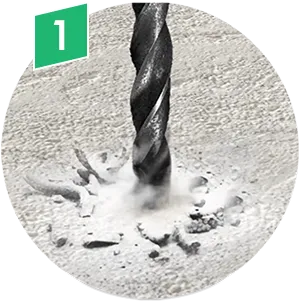
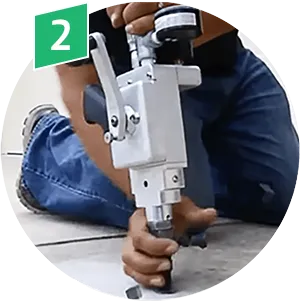
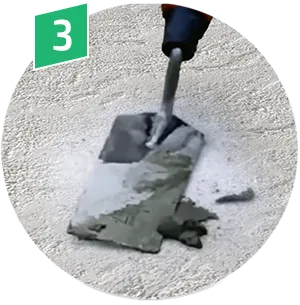

Polyurethane foam weighs very little compared with the soil or grout it replaces, so it doesn’t add load to soft ground. It cures into a closed-cell material that holds up in damp conditions.
Where the problem is a hollow area rather than a visible drop, void filling puts support back under the slab without raising it. For garage floors and other interior slabs, see concrete floor leveling.
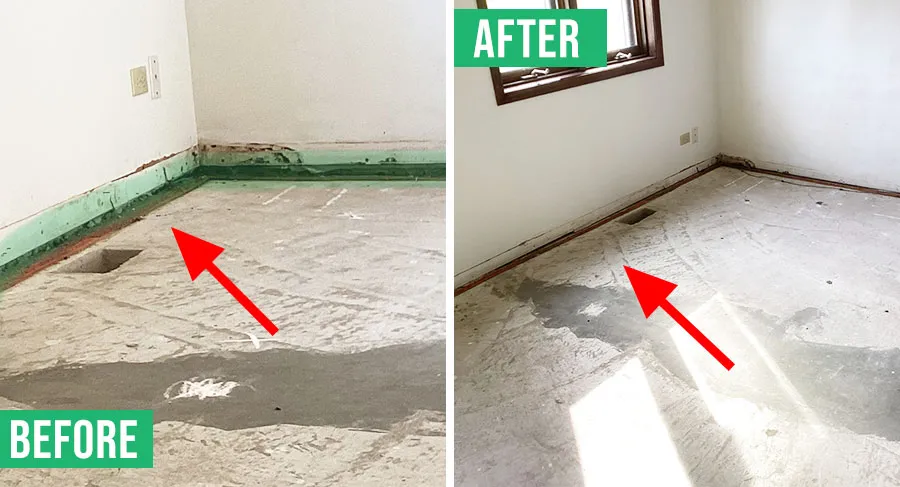
Before: Move furniture, boxes and appliances off the area. If the floor has carpet, tile or laminate, tell us when you request an estimate. Drill holes can sometimes be placed in an unfinished area, a closet, or along a wall.
After: Seal the cracks and the joint at the wall. The EPA lists cracks in solid floors and construction joints among the ways radon gets into a home (EPA A Citizen’s Guide to Radon). Lifting isn’t a radon fix, but it’s a good time to seal and to test.
If water caused the settlement, have the source fixed too, or it can wash out soil again.
In those cases, a local Foamjection professional will tell you so and explain what needs to happen first.
The foam is injected under the slab and cures into a solid. There may be a mild odor during injection that clears as it cures.
Sometimes. It depends on the flooring and where the low areas are. Some floor coverings need to be lifted where holes are drilled.
Lifting can bring the two sides of a crack back into line and stop it from getting worse. The crack itself is still there and should be sealed afterward.
Foam raises concrete. It can’t lower a slab that has been pushed up. A heaved floor usually points to water or soil pressure, and that needs a different evaluation.
Common signs are a hollow sound when you tap the floor, a crack with one side lower than the other, or a gap at the wall. A local professional can drill a test hole to confirm.
Call 866-913-6519 or request a free estimate. Send a few photos of the floor and the nearby walls, and Foamjection will connect you with a local concrete lifting professional who serves your area. See the full service area.
Foamjection helps homeowners with expert foam concrete leveling throughout.
