
Sunken driveway, sidewalk, steps or patio? Foamjection lifts and levels settled concrete in Monroe with high-density polyurethane foam, through small holes and with no tear-out. Most jobs take a few hours, and the surface is often ready to use the same day.
Prefer to talk? Call 866-913-6519
Reviewed by the Foamjection Team, powered by HMI · Updated October 29, 2026 · About Foamjection
Much of Monroe is low, flat ground near the Ouachita River, so rainwater tends to sit along the edges of a driveway instead of running off. The clay-rich soil there softens when it stays wet, and the slab edges and corners start to drop. A common sign is a lip where the driveway meets the garage floor.
Older neighborhoods like the Garden District, which runs along the Ouachita River and around Forsythe Park, have long stretches of aging walks. As the soil under them shifts, panels tip, lift at the joints or step down, and a raised edge becomes a trip hazard.
Building in Monroe’s Garden District began in the 1890s, and many homes across the city have concrete stoops and porches added over the years. When the soil under a stoop settles, the steps lean or separate from the house, leaving a gap that lets water in.
Backyard slabs often sit on fill that was never packed well, over soft river soil. As it settles, patios hold puddles or tilt toward the house, pool decks crack and drop around the edges, and AC pads lean.
Real Foamjection lifts on the kinds of slabs we fix for Monroe homeowners. Small holes, no tear-out.


Foamjection is powered by HMI, which provides the equipment, training and systems behind every lift. Here’s what you can expect when you call us about your Monroe concrete:

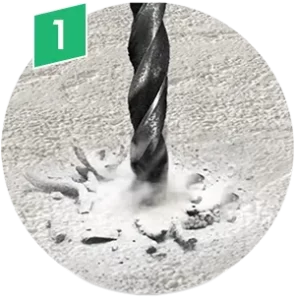 Drill Small Holes
Our crew drills small 5/8″ holes in key areas of the slab.
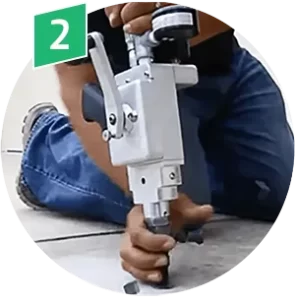 Inject High-Density Polyurethane Foam
This is the core of polyurethane concrete lifting — the foam expands beneath the slab, fills voids, stabilizes loose soils, and delivers a controlled slab lifting process.
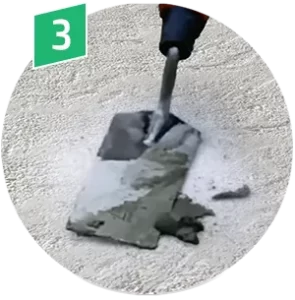 Patch & Use the Same Day
Once the slab reaches the correct height, holes are patched and the area is often ready to use within hours.
Tell us what’s sinking and where. A local pro will follow up with a free, no-pressure estimate.
Monroe sits on the Ouachita River, and the ground around the city was laid down by the river over thousands of years. The Louisiana Geological Survey’s geologic map of the Monroe South area shows the river’s natural levees here are grayish brown silty clay, with fine-grained backswamp deposits in the low flood basins between them. Elsewhere the map shows loose silty fine sand in old river channels, and layers of silt and dark, organic-rich clayey silt where the river once broke through its banks. On the older, higher ground the map shows silty to sandy clay and clayey fine sand.
That mix causes slabs to settle in a few ways. Clay soaks up water and swells, then shrinks and pulls away from the underside of a slab as it dries, so the ground under a driveway or walk keeps moving. Soft, wet clay and organic-rich silt also squeeze down under the weight of concrete over time. And where the soil is silty or sandy, heavy rain running along a slab edge can carry it away and leave a hollow. The concrete is still in one piece, but nothing is holding it up, so it drops.
Foam fills those hollows and firms up the soft soil around them, and because it is light, it doesn’t add much weight to soil that’s already struggling.
Source: Louisiana Geological Survey, Monroe South, LA 7.5-minute geologic quadrangle map, surface geology
Every service below uses the same foam lifting process, sized to the slab. Not sure which one you need? Describe the problem on the estimate form and a local pro will help you figure it out.
Yes. High-density polyurethane foam is moisture-resistant, so it doesn’t wash out or soften the way soil does when the ground stays wet after heavy rain. It’s also light, which matters on Monroe’s soft river soils. Keeping water moving away from the slab edge helps the whole area stay stable.
Yes. The foam expands into empty spaces under the slab and helps firm up soft or loose soil, which is the usual problem when clay shrinks away from a slab or silt washes out from under an edge. Steering water away from the slab edge helps the repair last.
Concrete jacking, also called slabjacking or mudjacking, pumps a heavy cement slurry under the slab through larger holes. Foam jacking uses high-density polyurethane foam through small 5/8 inch holes. The foam is much lighter, cures quickly, and most slabs are ready to use the same day.
It helps. On Monroe’s flat lots, roof water often pools right along slab edges, where it soaks into the clay and softens it, then the clay shrinks again as it dries. Extending downspouts and grading water away from the concrete keeps the soil under it steadier after the slab is lifted.
Yes. Foamjection also serves nearby communities including West Monroe, Richwood, Bastrop, Farmerville, Winnsboro and Ruston. You’ll find links to each area at the bottom of this page.
Fill out the estimate form on this page or call 866-913-6519. Estimates are free and no-pressure, and warranty details are explained before any work begins.
Foamjection also lifts and levels concrete in these communities near Monroe:
