
Sunken driveway, sidewalk, patio or pool deck? Foamjection lifts and levels settled concrete in Houston with high-density polyurethane foam, through small holes and with no tear-out. Most jobs take a few hours, and the surface is often ready to use the same day.
Prefer to talk? Call 866-913-6519
Reviewed by the Foamjection Team, powered by HMI · Updated October 29, 2026 · About Foamjection
Houston sits on clay that shrinks in long dry spells and swells again after heavy rain. A driveway poured on top of it rides that movement for years. Over time the edges and corners lose support, panels tip, and joints open up or form a lip where the drive meets the garage.
Older neighborhoods like Houston Heights, Woodland Heights, Norhill and Old Sixth Ward have mature trees along many of their walks. Large trees pull a lot of water out of clay, and as the clay dries it shrinks, so the panel above it can sink or tilt. In Houston, keeping the sidewalk next to your property in repair is the owner’s job.
Houston lots are mostly flat, so water from storms has nowhere fast to go. When a patio or pool deck settles even a little, puddles sit on it, water runs toward the house, and gaps open where the deck meets the pool coping or the slab meets the foundation.
Smaller slabs often sit on fill along the edge of the house, right where roof water and sprinkler water land. As that soil gets wet, dries out and settles, garage aprons leave a lip at the door, front steps pull away from the house, and AC pads lean.
Real Foamjection lifts on the kinds of slabs we fix for Houston homeowners. Small holes, no tear-out.


Foamjection is powered by HMI, which provides the equipment, training and systems behind every lift. Here’s what you can expect when you call us about your Houston concrete:

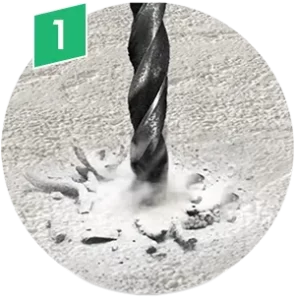 Drill Small Holes
Our crew drills small 5/8″ holes in key areas of the slab.
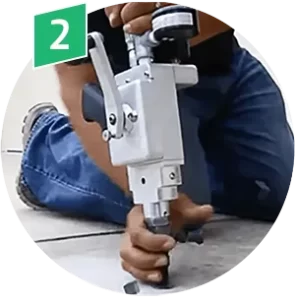 Inject High-Density Polyurethane Foam
This is the core of polyurethane concrete lifting — the foam expands beneath the slab, fills voids, stabilizes loose soils, and delivers a controlled slab lifting process.
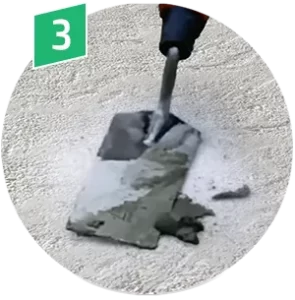 Patch & Use the Same Day
Once the slab reaches the correct height, holes are patched and the area is often ready to use within hours.
Tell us what’s sinking and where. A local pro will follow up with a free, no-pressure estimate.
Houston is built on the flat coastal plain of the Gulf Coast. Near the surface across Harris County is the Beaumont Formation, a muddy, clay-rich layer laid down on an old delta plain, according to the Texas Bureau of Economic Geology. The clay soils that formed on it across the coastal prairie of Southeast Texas crack open when they dry out, with cracks up to 2 inches wide that reach a foot or more deep, according to the USDA soil survey.
That clay is expansive. It swells when it takes on water and shrinks when it loses it, and large trees add to the drying as their roots pull water out of the clay.
For driveways, walks and patios, that means the ground underneath keeps moving. When the clay dries and shrinks, it pulls away from the bottom of the slab and leaves a gap. The concrete is still in one piece, but part of it is no longer supported, so it cracks, tips or drops.
Foam fills those gaps and firms up the soil right under the slab, and because it is light, it doesn’t add much weight to the clay. Foam can’t stop clay from shrinking and swelling, so keeping the soil around the slab at a steady moisture, with good drainage and sensible watering, helps the lift last.
Source: USDA Natural Resources Conservation Service, Official Soil Series Description, Lake Charles series
Every service below uses the same foam lifting process, sized to the slab. Not sure which one you need? Describe the problem on the estimate form and a local pro will help you figure it out.
In Houston, the property owner next to the sidewalk is responsible for repairing it. Houston Public Works says that “property owners of the adjoining sidewalk are responsible for the repair of existing sidewalks,” under Sections 40-83 and 40-84 of the City of Houston Code of Ordinances. The city’s Sidewalk Program builds new sidewalks and curb ramps but does not cover repairs. See the Houston Public Works Sidewalk Program FAQ. If your panels are intact and just sunken or tilted, ask us whether lifting is an option before you replace them.
Yes. When clay shrinks and pulls away from a slab, the foam expands into the empty space and helps support the slab again. Clay will still swell and shrink with the weather, so steady moisture and good drainage around the slab help the repair last.
Concrete jacking, also called slabjacking or mudjacking, pumps a heavy cement slurry under the slab through larger holes. Foam jacking uses high-density polyurethane foam through small 5/8 inch holes. The foam is much lighter, cures quickly, and most slabs are ready to use the same day.
It helps. In Houston, the problem is clay that swings from soaked to dry. Extending downspouts, fixing spots where water pools along slab edges, and watering evenly in long dry spells all help keep the clay under your concrete from shrinking and swelling as much after it is lifted.
Yes. Foamjection also serves nearby communities including Bellaire, Jacinto City, Galena Park, South Houston, Jersey Village and Stafford. You’ll find links to each area at the bottom of this page.
Fill out the estimate form on this page or call 866-913-6519. Estimates are free and no-pressure, and warranty details are explained before any work begins.
Foamjection also lifts and levels concrete in these communities near Houston:
