
Sunken driveway, sidewalk, steps or patio? Foamjection lifts and levels settled concrete in Argyle with high-density polyurethane foam, through small holes and with no tear-out. Most jobs take a few hours, and the surface is often ready to use the same day.
Prefer to talk? Call 866-913-6519
Reviewed by the Foamjection Team, powered by HMI · Updated October 29, 2026 · About Foamjection
Argyle is a town of larger lots, and many homes sit well back from the road at the end of a long driveway. The edges of a long drive take runoff from the yard and the roof, and when the soil along the side washes out or dries and shrinks, panels tip, crack and leave uneven joints.
The apron outside the garage door sits on open ground, while the garage floor is sheltered. When the soil under the apron settles, it drops below the floor and leaves a lip or gap at the door that catches tires and lets water run toward the garage.
The walk from the driveway to the front door and the steps at the entry often sit on soil that was dug out and filled back in when the house was built. As that fill settles, panels become trip hazards and steps lean or pull away from the house, leaving a gap where water gets in.
Backyard patios and pool decks, detached garage and shop slabs, and AC pads are usually poured on fill that was never packed well. As it settles, slabs hold puddles, tilt toward the house, or rock under weight.
Real Foamjection lifts on the kinds of slabs we fix for Argyle homeowners. Small holes, no tear-out.


Foamjection is powered by HMI, which provides the equipment, training and systems behind every lift. Here’s what you can expect when you call us about your Argyle concrete:

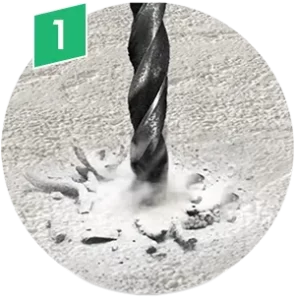 Drill Small Holes
Our crew drills small 5/8″ holes in key areas of the slab.
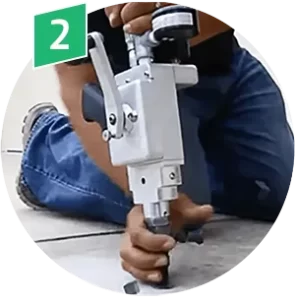 Inject High-Density Polyurethane Foam
This is the core of polyurethane concrete lifting — the foam expands beneath the slab, fills voids, stabilizes loose soils, and delivers a controlled slab lifting process.
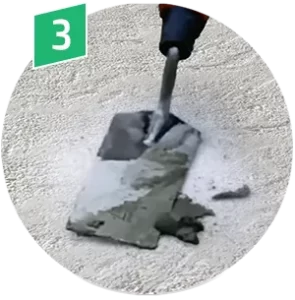 Patch & Use the Same Day
Once the slab reaches the correct height, holes are patched and the area is often ready to use within hours.
Tell us what’s sinking and where. A local pro will follow up with a free, no-pressure estimate.
Argyle sits where two kinds of North Texas ground meet. According to the U.S. Geological Survey’s Geologic Database of Texas, the center and east side of town sit on the Woodbine Formation, layered beds of sand, clay, sandstone and shale. Parts of the west side sit on a band of limy clay and limestone instead.
The USDA Natural Resources Conservation Service describes the soils that form on sandstone and shale in this part of Texas as deep and highly weathered, and notes that some have clayey subsoils over claystone or shale. On the limestone and shale side, it notes that clayey soils formed from shale have shrink-swell properties.
That mix makes slabs settle in two ways. Where the soil under a slab is sandy or loose, water running along the edge from a roof, a yard or a heavy storm can carry it away and leave a hollow. Where it is clay, the soil shrinks as it dries out in a long dry spell and swells again when it gets wet, so the support under the slab keeps moving. Either way the concrete is often still in one piece, but nothing is holding it up evenly, so it drops or tips.
Foam fills those hollows and firms up the loose soil around them, and because it is light, it doesn’t add much weight to soil that’s already struggling.
Source: U.S. Geological Survey, Geologic Database of Texas, 1:250,000, Sherman sheet
Source: USDA Natural Resources Conservation Service, General Soil Map of Texas
Every service below uses the same foam lifting process, sized to the slab. Not sure which one you need? Describe the problem on the estimate form and a local pro will help you figure it out.
Yes. The foam expands into empty spaces under the slab and helps stabilize loose soil, whether the hollow came from sandy soil washing out or from clay shrinking during a dry spell. Steering water away from the slab edge helps the repair last.
Yes. The process is the same on a long driveway, a detached garage or shop slab, or a pool deck as it is on a front walk. The job is simply sized to the slab. Describe what’s sinking on the estimate form and a local pro will look at the whole area with you.
Concrete jacking, also called slabjacking or mudjacking, pumps a heavy cement slurry under the slab through larger holes. Foam jacking uses high-density polyurethane foam through small 5/8 inch holes. The foam is much lighter, cures quickly, and most slabs are ready to use the same day.
It helps. In Argyle, water running off roofs and yards along slab edges is a common reason soil washes out, and big swings between wet and dry make clay soil shrink and swell. Extending downspouts and keeping water from running along slab edges helps keep new hollows from forming after the concrete is lifted.
Yes. Foamjection also serves nearby communities including Flower Mound, Highland Village, Trophy Club, Denton, Justin and Ponder. You’ll find links to each area at the bottom of this page.
Fill out the estimate form on this page or call 866-913-6519. Estimates are free and no-pressure, and warranty details are explained before any work begins.
Foamjection also lifts and levels concrete in these communities near Argyle:
